
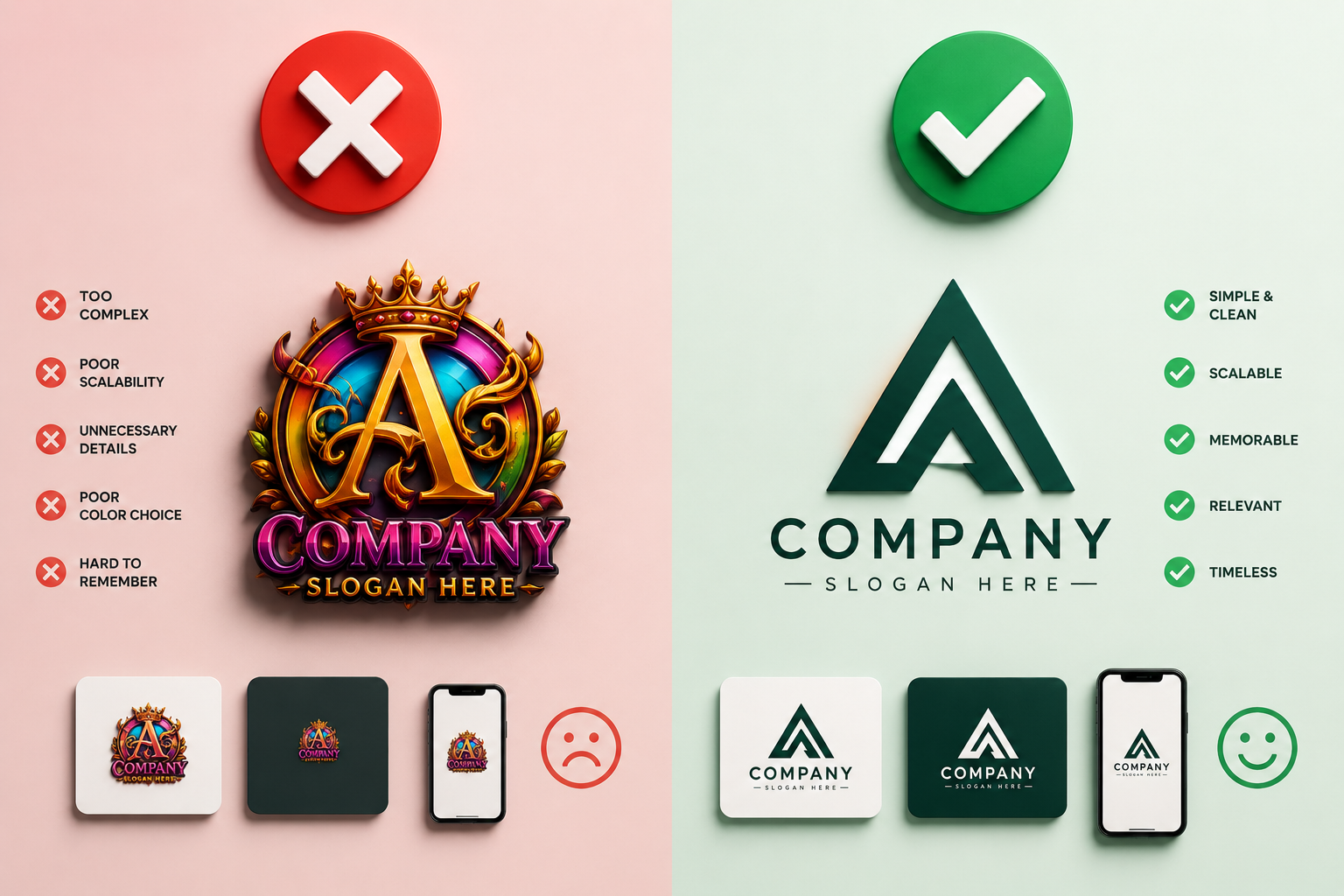
In the modern digital economy, your custom logo serves as the absolute psychological anchor of your corporate identity. It is the visual representation of your brand value and customer promise. However, creating an impactful visual mark using an AI logo maker or professional designer is an intricate balancing act. A single architectural misstep in your design can silently alienate potential clients, erode digital trust, and cost your enterprise thousands of dollars in future rebranding.
Many ambitious entrepreneurs fall victim to the 'kitchen sink' syndrome, desperately trying to cram their company history and multiple product lines into a single tiny emblem. Using a free logo maker incorrectly can result in overcomplicated logos that degrade into an unrecognizable smudge on social media. To protect your brand equity, we have compiled an exhaustive analysis of the 10 most devastating logo design mistakes and provided the precise technical remedies needed to ensure your visual identity scales perfectly across all global platforms.
1. RELYING ON CHEAP TEMPLATES AND STOCK VECTORS
One of the most fatal branding errors a business can make is relying on generic stock vectors or heavily used templates. When you download a cheap, pre-made logo, you are inevitably sharing your core brand identity with thousands of other companies worldwide. This completely destroys any chance of building a unique, recognizable brand footprint. Customers can subconsciously detect generic artwork, which immediately lowers their perception of your company's value, professionalism, and trustworthiness.
The fix is to prioritize absolute originality. Whether you are collaborating with a human designer or utilizing an advanced AI logo generator, you must insist on a bespoke, custom creation. Your logo must be uniquely tailored to your specific corporate narrative and market positioning. Originality is the only way to secure robust legal trademark protection and ensure that your brand stands out in a hyper-competitive digital ecosystem.
2. OVERCOMPLICATING THE VISUAL STRUCTURE
Logo design is an exercise in subtraction, not addition. A massive mistake made by novice designers is attempting to illustrate every single service a company offers within the logo. Complex illustrations, intricate linework, and dense visual metaphors create a cluttered mess that is impossible for the human brain to process at a glance. When an overly complex logo is scaled down for a mobile app icon or a website favicon, it devolves into an illegible inkblot.
To resolve this, embrace hyper-minimalism. Strip away every non-essential line, shadow, and decorative element until only the fundamental core of the concept remains. The most iconic global brands—Nike, Apple, McDonald's—rely on singular, hyper-simple geometric shapes. A simple logo ensures flawless scalability, instant cognitive recognition, and a timeless aesthetic that will never feel cluttered or overwhelming to your audience.
3. CHOOSING THE WRONG TYPOGRAPHY AND FONTS
Typography dictates the audible voice of your brand. Selecting a font that clashes with your corporate identity is a critical error. For example, using a playful, comic-style font for a serious law firm destroys all credibility. Additionally, using too many different fonts in a single logo creates visual chaos. Many brands also choose ultra-thin or overly stylized fonts that become completely unreadable when viewed from a distance or on a small smartphone screen.
The solution is to limit your logo to a maximum of two harmonized typefaces. Choose a primary font that accurately reflects your brand's personality—a solid Serif for tradition and trust, or a clean Sans-Serif for modern innovation. Ensure the kerning (the space between letters) is mathematically balanced and that the font remains highly legible across all digital and print mediums.
4. DESIGNING IN RASTER FORMATS INSTEAD OF VECTORS
A devastating technical mistake is creating a logo using pixel-based (raster) software like Adobe Photoshop. Raster images consist of a fixed grid of colored squares. The moment you attempt to enlarge a raster logo for a banner or billboard, the image instantly pixelates, blurring into an unprofessional, jagged mess. This technical flaw renders the logo completely useless for professional physical branding.
Logos must always be designed natively in vector formats (such as AI, EPS, or SVG) using programs like Adobe Illustrator. Vector graphics rely on mathematical equations, meaning they can be infinitely scaled—from a tiny business card to a skyscraper-sized billboard—without ever losing a single drop of crispness or quality. Always demand vector source files from your designer or logo maker.
5. IGNORING COLOR PSYCHOLOGY AND BRAND IDENTITY
Choosing colors based purely on personal preference rather than psychological strategy is a massive misstep. Colors trigger deep subconscious emotional responses. If a healthcare company chooses aggressive neon reds instead of calming, trustworthy blues or greens, they are sending the wrong psychological signal to their patients. Furthermore, relying entirely on color to make a logo understandable means the logo will fail when printed in grayscale.
Always design the core structure of your logo in pure black and white first. If the silhouette does not work, no amount of color will save it. Once the structure is perfected, strategically apply one or two primary colors that align perfectly with the emotional triggers of your target demographic, ensuring high contrast and digital legibility.
6. FOLLOWING SHORT-LIVED DESIGN TRENDS
Design trends move at lightning speed. Building your brand's permanent identity around a temporary fad—such as neon 3D gradients, glitch art, or a specific trendy font—guarantees that your logo will look hilariously outdated within a few years. Trendy logos lack the enduring power required to build long-term generational brand equity.
Focus on timeless design principles. Aim for classic geometry, balanced proportions, and clean lines. A truly great logo should look as modern and authoritative twenty years from now as it does today. By ignoring passing fads, you protect your company from the massive financial burden of constant rebranding efforts.
7. CREATING LOGOS THAT LACK SCALABILITY
A logo that looks stunning on a large desktop monitor but turns into an illegible blur on a mobile screen is a failed design. Many designers create wide, horizontal lockups that simply do not fit into the square or circular constraints of modern social media profile pictures, resulting in awkwardly cropped or microscopic brand marks.
The fix is to engineer a 'responsive logo system'. Your brand guidelines must include multiple variations of your logo: a full horizontal version for website headers, a stacked vertical version for print, and a hyper-minimalist icon or monogram for tight digital spaces. This ensures your brand is flawlessly represented across the entire digital ecosystem.
8. DESIGNING FOR YOURSELF, NOT YOUR AUDIENCE
Entrepreneurs frequently force their personal artistic preferences onto their corporate branding, completely ignoring what actually resonates with their paying customers. If you are launching a B2B finance firm, your logo needs to project authority and security, even if your personal favorite aesthetic is bright, playful graffiti.
Remove your personal ego from the equation. Base every design decision on hard demographic data and consumer psychology. Your logo is not a personal art project; it is a highly calibrated corporate asset designed specifically to attract, convert, and retain your target market.
9. FORGETTING BLACK AND WHITE FUNCTIONALITY
Relying on shadows, gradients, and subtle color shifts to define the shapes in your logo is a major flaw. When your logo needs to be laser-engraved onto a product, embossed onto cardboard packaging, or printed in a single-color newspaper ad, those subtle gradients will disappear, leaving behind a confusing, formless blob.
Your logo must have a strict, high-contrast, single-color (monochrome) version. The positive and negative space must work together to create a clearly definable shape without any reliance on color depth. This ensures your logo remains powerful and functional across every possible physical manufacturing process.
10. FAILING TO SECURE TRADEMARK AND COPYRIGHTS
The final and most legally devastating mistake is launching a brand globally without conducting a thorough trademark search. If your new logo accidentally infringes on an existing registered trademark, you face the very real threat of crippling lawsuits, forced rebranding, and the total loss of all accumulated brand equity.
Before finalizing any design, employ legal counsel or utilize official government trademark databases to verify that your logo concept and brand name are completely unencumbered. Securing the intellectual property rights to your logo is the only way to safeguard your corporate valuation and operate safely in the global market.