
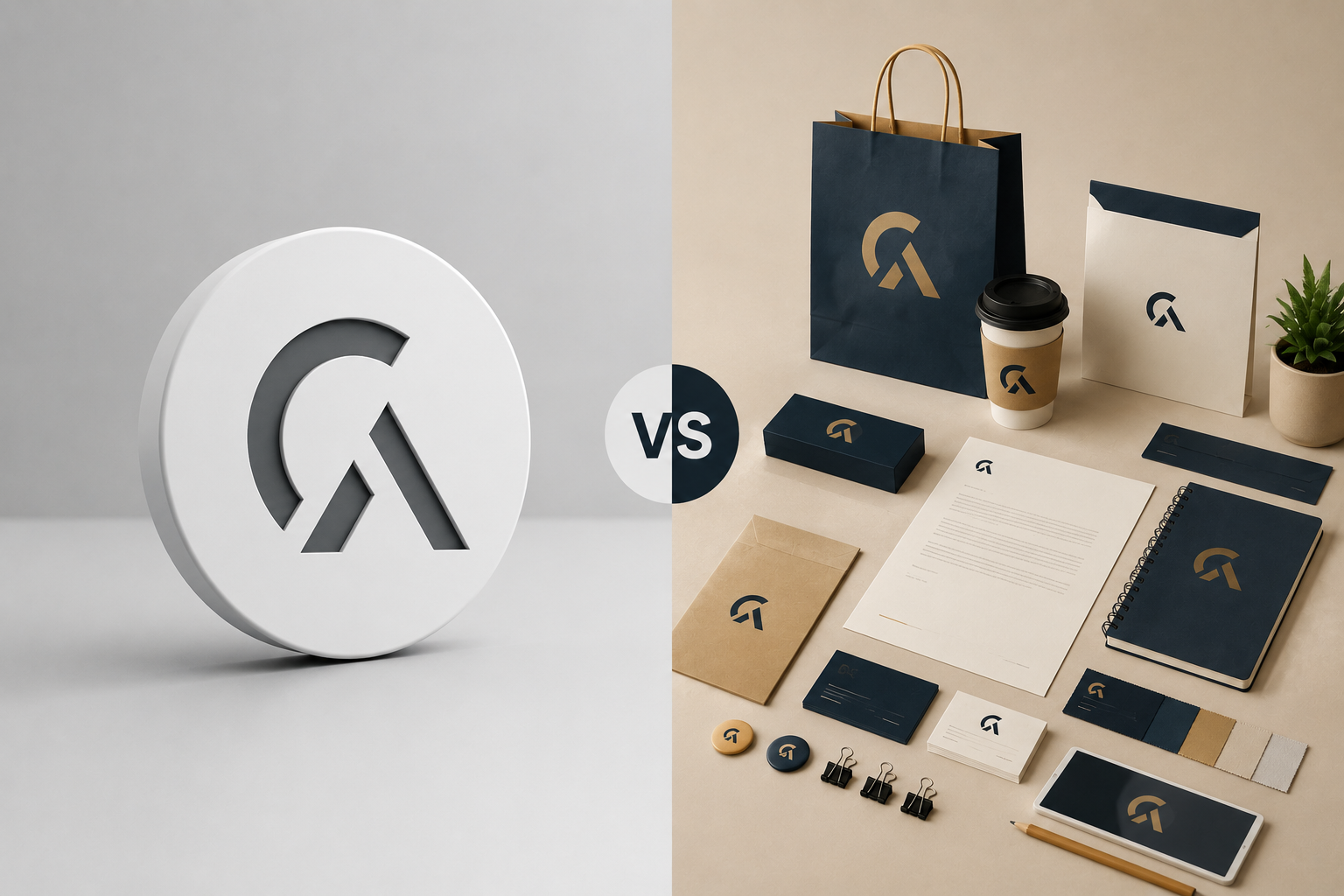
In the fast-paced business world, there are two fundamental concepts that are most often confused, conflated, and frequently used interchangeably by novice entrepreneurs: Logo and Brand Identity. Most new business owners operate under the dangerous assumption that they have completed the entire branding process simply by paying a designer to create a visually pleasing logo. However, treating a logo as the entirety of your brand is like assuming the front door of a house is the entire architectural structure. It is merely the visible tip of a massive, strategic iceberg. Understanding precisely what a logo is, what a brand identity encompasses, the stark differences between them, and how they must form an inseparable, synergistic whole is the absolute foundational requirement for building a resilient, long-lasting corporate structure that can survive in a highly saturated global marketplace.
1. DEFINING THE LOGO: YOUR CORPORATE SIGNATURE
A logo is, at its core, a precise graphical symbol, mark, or typographic execution that represents your company's identity in the simplest, fastest, and most easily recognizable way possible. The fundamental, overriding purpose of a logo is not to communicate complex ideas, explain your business model, or tell a long story; its sole purpose is to directly and instantly 'identify'. Think of it as the ultimate corporate signature. When you see the golden arches of McDonald's or the simple swoosh of Nike, those logos do not explain that the companies sell hamburgers or athletic shoes. Instead, they act as rapid cognitive triggers that identify the entity behind the product. A logo is a visual stamp, a mark of ownership that you place on your documents, digital assets, and physical packaging that allows your customers to immediately recognize your presence in a crowded and noisy market. It must be simple, memorable, and infinitely scalable.
2. DEFINING BRAND IDENTITY: THE ECOSYSTEM OF YOUR BUSINESS
Brand identity, in stark contrast, is the comprehensive, overarching strategic and visual ecosystem that houses your logo. If your logo is the face of a person, the brand identity is their entire character. You can identify a person solely by looking at their face, but how they speak, the clothes they wear, their core beliefs, their tone of voice, and their general demeanor form their true identity. Brand identity is a complete, rigid set of rules encompassing the precise usage guidelines for your logo, the mathematically designated corporate color palettes, the specific typography and font families used in your communications, the exact style of photography and illustration permitted, the tactile feel of your packaging designs, and the psychological tone of voice you deploy when speaking to your customers. It is the holistic sensory experience a consumer has when interacting with your business at any possible touchpoint.
3. THE LIMITATIONS OF A STANDALONE LOGO
The greatest danger a company faces is deploying a beautiful logo without a supporting brand identity system. A standalone logo has severe limitations. It cannot dictate the emotional tone of a marketing campaign. It cannot ensure that your social media graphics look cohesive. It cannot guide a web developer on what hover states or button colors to use. When a company relies solely on a logo, every new piece of marketing material becomes a random, disjointed experiment. An employee might use a playful font on an Instagram post, while another uses a sterile, corporate font on a sales brochure. This lack of a unified system leads to visual chaos. No matter how brilliantly designed the logo itself is, the surrounding chaos makes the brand appear deeply amateurish, disorganized, and untrustworthy to the consumer. A logo without a brand identity is a king without a kingdom; it holds a title, but possesses no actual power or structure to rule.
4. HOW BRAND IDENTITY MULTIPLIES THE POWER OF A LOGO
When a logo is embedded within a robust brand identity system, its power is multiplied exponentially. The identity system provides the critical context that the logo needs to thrive. For example, if your logo is a sleek, modern geometric shape, your brand identity system ensures that the accompanying typography is equally sharp, the color palette is highly contrasted and futuristic, and the brand voice is authoritative and forward-thinking. This complete alignment creates a compounding psychological effect. Every time a consumer interacts with a perfectly aligned Instagram post, reads a well-toned email, or unpacks a beautifully designed product, the positive associations are subconsciously funneled back into the logo. Over time, the logo absorbs all of these positive experiences. It becomes a vessel filled with meaning, trust, and emotional resonance. The brand identity does the heavy lifting of building the relationship, while the logo serves as the powerful, instantly recognizable anchor that holds it all together.
5. THE ROLE OF BRAND GUIDELINES IN MAINTAINING ORDER
The physical manifestation of the difference between a logo and a brand identity is the 'Brand Guidelines' document (often called a Brand Book). If you only have a logo, you merely have a folder containing a few PNG and SVG files. If you have a brand identity, you possess a comprehensive, multi-page manual that dictates exactly how the brand must behave. This document outlines the precise clear-space required around the logo, the specific HEX and CMYK codes for the primary and secondary color palettes, the typographic hierarchy (H1, H2, body text sizes and weights), and detailed examples of acceptable and unacceptable brand applications. It serves as the ultimate corporate law for visual and verbal communication. This ensures that whether an internal junior designer, a freelance copywriter, or a massive global advertising agency is working on your account, the output remains ruthlessly consistent, protecting the integrity of the brand identity across decades and continents.
6. THE ULTIMATE SYNERGY FOR MARKET DOMINANCE
Ultimately, debating whether a logo or a brand identity is more important is a flawed exercise; they are fundamentally symbiotic. A strong brand identity requires a distinctive logo to act as its focal point, its flag planted in the ground. Conversely, a brilliant logo requires a comprehensive brand identity to give it meaning, context, and emotional depth. To achieve true market dominance, you must invest equally in both. The logo acts as the sharp tip of the spear that pierces the consumer's consciousness, grabbing their attention in a fraction of a second. The brand identity is the heavy, powerful shaft of the spear that drives the message home, delivering the emotional weight, the consistency, and the deeply rooted trust that converts a fleeting glance into lifelong brand loyalty. To build a legacy, you must architect the entire spear, not just polish the tip.
7. THE EVOLUTION OF A LOGO WITHIN A MATURE IDENTITY
As a brand identity matures and gains massive equity in the marketplace, the logo itself often undergoes a process of extreme simplification. Consider global giants like Starbucks, Nike, or Mastercard. In their early years, their logos contained the full company name, detailed illustrations, and complex coloring to explicitly explain who they were. However, as their holistic brand identity—their store experiences, their advertisements, their product quality—became globally recognized, they no longer needed the logo to do the heavy lifting of explanation. They systematically stripped away the text and complex details, leaving only the purest, most minimal geometric core of the original mark. This evolution is only possible because the surrounding brand identity is so overwhelmingly strong that the barest visual suggestion of the logo is enough to trigger instant, total brand recall.
8. AUDITING YOUR BRAND: IS YOUR LOGO OUTPERFORMING YOUR IDENTITY?
To diagnose the health of your corporate presentation, you must conduct a blind visual audit. Remove your logo from your website, your brochures, and your social media posts. Now, look at what remains. Are the colors, the typography, the photography style, and the tone of voice still instantly recognizable as belonging to your company? If a consumer looking at your logoless website cannot immediately tell it is you, your brand identity is critically weak, and you are dangerously reliant on your logo. A true, world-class brand identity guarantees that every single fragment of communication possesses an unmistakable 'fingerprint', rendering the logo itself almost secondary to the overarching visual and emotional experience.