
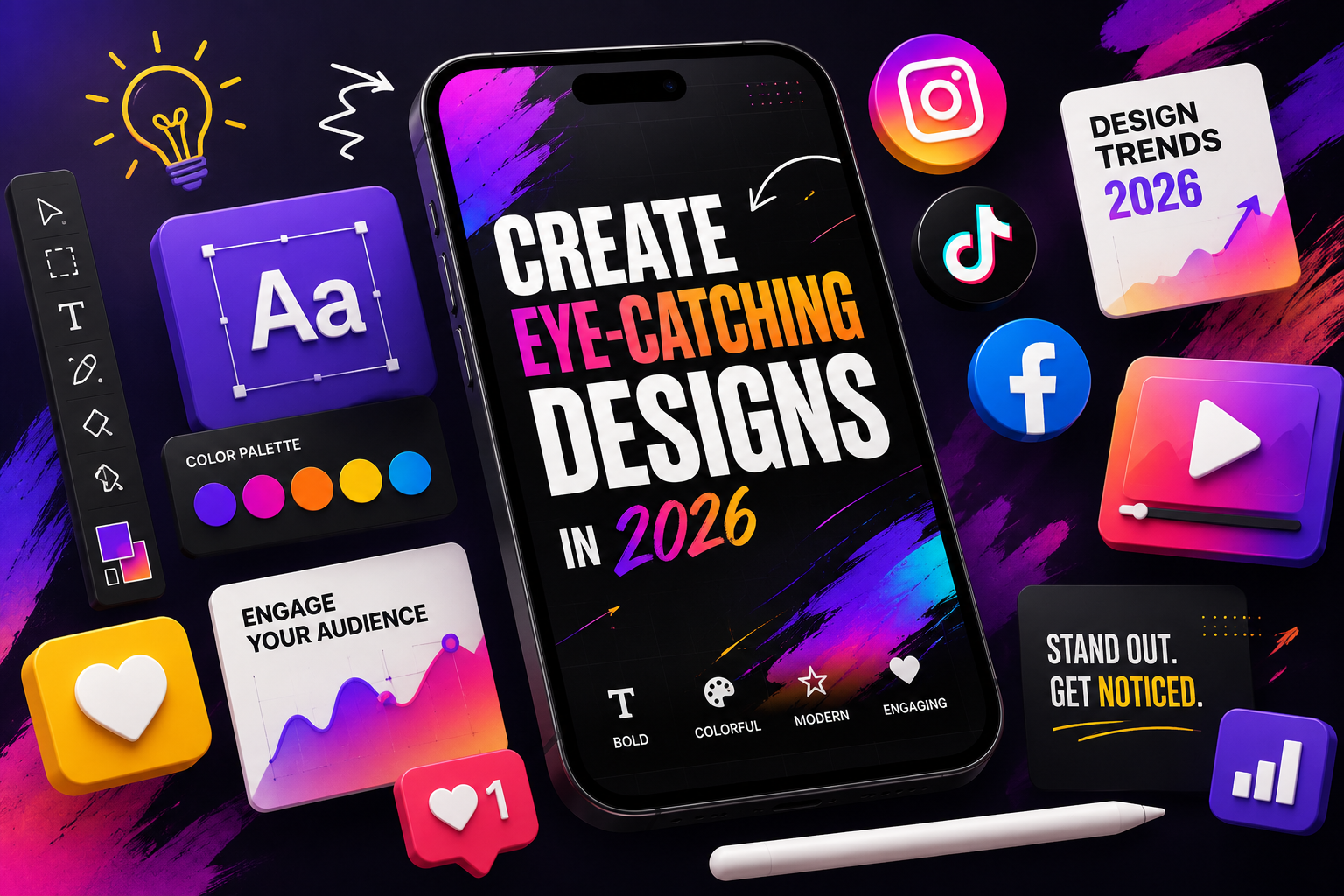
In the hyper-accelerated digital ecosystem of 2026, social media algorithms and consumer browsing behaviors have undergone a profound shift. With the average human attention span on algorithmic feeds compressed to just 1.7 seconds, traditional static graphics are no longer effective. Securing organic visibility and maximizing engagement rates now demands a highly strategic fusion of custom logo design, advanced AI infrastructure, and multi-dimensional visual engineering.
1. THE KINETIC TYPOGRAPHY REVOLUTION AND FLUID TYPEFACES
Typography in 2026 is no longer a static element designed simply to be read; it is a dynamic performer designed to be watched. Incorporating your professional brand identity and custom logo seamlessly into kinetic typefaces drastically lowers bounce rates. By deploying next-generation fonts and AI-driven layout generators, digital creators can ensure their visual content intercepts user attention instantly.
2. EMBEDDING ABSTRACT 3D ELEMENTS AND DEPTH ILLUSIONS
The flat, two-dimensional minimalism that saturated social media platforms for the past decade has completely lost its ability to arrest the consumer's eye. Modern algorithmic feeds are now dominated by high-fidelity abstract 3D models and hyper-realistic depth illusions that appear to physically protrude from the flat glass of smartphone screens. These organic textures, metallic chrome accents, and floating geometric shapes generate an immediate spatial contrast within a crowded timeline, forcing the user's brain to break its automated scrolling pattern. To optimize these assets without sacrificing layout speed, forward-thinking brands use WebGL-optimized 3D libraries to render lightweight, hyper-polished micro-assets that load instantly on low-bandwidth mobile networks.

3. AI-DRIVEN HYPER-PERSONALIZATION AND SYNTHETIC PHOTOGRAPHY
Artificial intelligence has transitioned from a mere novelty tool into the absolute engine of modern creative workflows. However, generic, unpolished AI outputs are heavily penalized by both savvy consumers and platform algorithms. In 2026, market leaders leverage proprietary, fine-tuned machine learning models trained exclusively on their specific corporate brand guidelines. This allows for the instant generation of synthetic photography—producing studio-grade product placements, localized background adaptations, and context-aware lighting schemes tailored to the real-time geographic and demographic data of the individual user viewing the feed, driving conversion metrics to unprecedented highs.
4. MOBILE-FIRST RESPONSIVE HIERARCHIES AND THE VERTICAL DOMINANCE
With over 92% of global social media consumption occurring on mobile screens, designing layouts on wide desktop monitors without a strict mobile-first engineering framework is a critical mistake. Traditional 1:1 square aspect ratios are rapidly losing real estate to the complete vertical immersion of 4:5 carousels and 9:16 video formats. Every layout must be meticulously engineered within strict platform 'safe zones' to prevent crucial text layers, brand logos, or core call-to-action (CTA) triggers from being obstructed by native app interfaces, user comment sections, or overlay icons.
5. AUGMENTED REALITY (AR) FILTER SYSTEMS AND INTERACTIVE USER INTERFACES
Passive content consumption has officially been replaced by interactive co-creation. Incorporating Augmented Reality (AR) filter architectures directly into your social design funnel transforms static viewers into active brand ambassadors. Whether through virtual product try-ons, spatial environmental gamification, or face-tracking kinetic masks, interactive asset design triggers an exponential organic reach multiplier. When a user captures a story using your customized brand asset, they seamlessly inject your visual identity into their personal networks, bypassing algorithmic reach throttles entirely.
6. ECO-AESTHETICS AND THE PSYCHOLOGY OF SUSTAINABLE NATURAL PALETTES
The continuous onslaught of high-saturation neon colors and aggressive digital hyper-exposure has resulted in a widespread consumer psychological phenomenon known as 'visual fatigue'. In response, the 2026 design space has embraced Eco-Aesthetics—a deliberate migration toward soothing, organic color palettes. Dominant tones like muted sage greens, warm terracottas, unbleached linen linen, and mineral grays are mathematically proven to lower cognitive stress markers, cultivating immediate psychological safety, corporate authenticity, and profound consumer trust.
7. CONTROLLED MAXIMALISM: THE Y2K NOSTALGIA AND RETRO-FUTURISM BLEND
While minimalism serves corporate clarity, Gen Z and Alpha demographics are overwhelmingly drawn to the chaotic energy of Controlled Maximalism. This design movement masterfully blends late-90s cyber-optimism (Y2K) with raw retro-futurism. By juxtaposing acid-house color accents, pixelated typography layouts, chrome textures, and analogue film grains over contemporary clean grid frameworks, designers evoke an intense wave of nostalgia while simultaneously presenting a cutting-edge, rebellious aesthetic that breaks the monotony of generic corporate feeds.

8. DARK MODE OPTIMIZATION AND HIGH-CONTRAST OLED STRATEGIES
A staggering majority of modern mobile device users keep their operating systems locked permanently in Dark Mode. Graphic assets built on flat, blinding white canvases disrupt the user experience, causing immediate swipe-away reactions during late-night browsing sessions. Visual engineers must test every single creative asset inside a dark sandbox environment, deploying deep pure black (#000000) backgrounds that integrate seamlessly with native OLED smartphone hardware. This technique allows neon accents and high-contrast pastel text layers to vibrantly pop off the screen while maximizing battery performance and reading comfort.
9. MICRO-ANIMATIONS AND ATTENTION SPAN ENGINEERING
You do not need to produce complex, high-budget multi-minute cinematic videos to capture attention. Implementing the principles of Attention Span Engineering through subtle micro-animations (looping graphical elements) is vastly more cost-effective and structurally impactful. A floating background shadow, a gently pulsating call-to-action button, or a glowing neon pointer arrow creates just enough subconscious movement to lock the user's eyes onto your layout, guiding their visual focus precisely down to your primary value proposition.
10. DATA-DRIVEN INFOGRAPHICS FOR HIGHER SAVES AND BACKLINKS
Google's sophisticated search engines heavily reward content that establishes authentic, undeniable authority. Translating dense, complex industry reports, fiscal statistics, and white-paper analytics into highly scannable, beautifully organized info-graphics satisfies the search intent of users and search engines alike. In social spaces, data-driven infographics generate an exceptionally high 'Save' and 'Share' ratio—metrics that platform algorithms prize above all else—while simultaneously acting as powerful magnets for high-authority backlink acquisition when embedded into your corporate blog infrastructure.

11. INTEGRATING USER-GENERATED CONTENT (UGC) INTO PREMIUM LAYOUT SYSTEMS
Modern digital consumers have developed an acute resistance to over-polished, sterile corporate advertisements; they crave the raw authenticity of human peer reviews. However, simply reposting unedited, low-resolution user-generated content (UGC) can severely degrade your premium brand aesthetic. The solution lies in engineering structured, high-end frame components, minimalist text layouts, and custom grid systems that beautifully house raw smartphone footage or customer reviews, perfectly balancing grassroots authenticity with elite corporate design execution.
12. THE RISE OF DE-BRANDING AND RAW BRUTALIST DIGITAL LAYOUTS
De-branding is a highly advanced psychological design strategy where a multi-million dollar corporation intentionally styles its social media outputs to look like a casual, unedited text post or a simple screenshot from a smartphone Notes application. By utilizing raw, unaligned brutalist layouts, default system fonts (such as Arial or Helvetica), and removing massive corporate branding badges, your content blends seamlessly into the organic posts of your user's close friends, instantly bypassing their subconscious ad-defense mechanisms.
13. COGNITIVE COLOR MAPPING AND CROSS-PLATFORM CONVERSION ARCHITECTURE
Colors should never be chosen based on subjective artistic moods; they are precise psychological triggers that dictate cross-platform conversion behavior. By establishing a rigid Cognitive Color Map across your social channels, you systematically train your audience's brain to react. For instance, dedicating a high-contrast safety orange or a specific electric teal exclusively to your actionable transactional prompts ensures that as users scan at lightning speeds, their subconscious brain instantly flags that specific color vector as an interactive, high-value node.
14. METRIC-DRIVEN CREATIVE A/B TESTING AND ALGORITHMIC ITERATION
The final, most critical pillar of 2026 social design engineering is completely eliminating creative guesswork from your production lifecycle. No design framework is absolute until it is empirically validated by live user metrics. Visual design teams must systematically deploy programmatic A/B testing—simultaneously running variations of focal imagery, color contrast distributions, and typographical scaling hierarchies. By constantly monitoring click-through rates (CTR), dwell time metrics, and cost-per-acquisition (CPA) values, you turn your design assets into a data-backed machine optimized for search engines and social algorithms alike.