
In today's highly competitive business world, an effective custom logo is one of the most critical elements that separates your brand from the rest. The question of how to design a logo is one of the first things that comes to mind when starting a new venture or using an online logo maker. A successful logo is not just an aesthetically pleasing visual; it is a powerful communication tool that establishes brand trust and drives customer loyalty.
In this comprehensive guide, we will examine all the stages of designing a professional logo from scratch, whether you are using Adobe Illustrator or an AI-driven logo creator. We'll cover golden rules accepted in the design world, the depths of color psychology, typography selection, and the best logo making programs. If you want to rank high in the digital world and build an unshakable brand identity, this guide is exactly for you.
1. WHAT IS LOGO DESIGN AND WHY IS IT SO IMPORTANT?
Logo design is a combination of symbols, text, letters, and colors that visually represent a company, product, service, institution, or idea. In short, a logo is the outward-facing face of your brand. When people first encounter your brand, website, or social media accounts, they will most likely see your logo first, and this first impression largely determines what they will think about your brand and whether they will trust you.
So, why is a logo so important in the business world? First, it strengthens the first impression and influences the decision process. It usually takes seconds for consumers to decide about a brand. When the target audience sees your logo, they subconsciously form a judgment about whether your brand is reliable. An impressive and professional logo makes your quality felt instantly. Second, it builds corporate brand identity. The foundation of corporate identity design is always the logo. Your logo will be used everywhere, from your website to your business card, from your social media accounts to your packaging, from letterheads to invoices.
Third, it increases memorability and brand loyalty. The human brain processes and remembers visuals, shapes, and colors much faster than text. Think of Nike's Swoosh, McDonald's golden arches, or Apple's bitten apple; even if you do not see the company names, you recognize them. Fourth, it definitely separates you from your competitors. You may have dozens, hundreds, or even thousands of competitors operating in the same sector. An original, innovative, and industry-appropriate logo design takes you out of this crowd and positions you differently. Finally, it builds professionalism and trust. A professionally designed logo sends a message to the customer that you take this business seriously and have a corporate structure.
2. THE FUNDAMENTAL RULES OF EFFECTIVE LOGO DESIGN (GOLDEN PRINCIPLES)
Before asking how to make a logo or how to design an emblem, it is necessary to answer the question of how a good logo should objectively be. When we look at the common features of iconic logos accepted worldwide, five basic universal principles emerge. Adhering to these golden rules is the key to a successful logo creation process.
Simplicity is the first rule. Logos full of tiring, complex details and intricate illustrations usually fail and are not remembered. A simple logo is easily recognized, engraved in the mind, and works seamlessly in different sizes. Avoid unnecessary lines, multiple complex color transitions, and hard-to-read fonts in your design. The philosophy of less is more is the foundation of logo design.
Memorability is the natural and inevitable result of the simplicity rule. An effective logo design should be engraved in the memory even when seen once or out of the corner of the eye. If the viewer can outline your logo on a piece of paper after seeing it for a few seconds, you have succeeded. Too much detail tires the memory, while simple geometric forms remain in the mind.
Timelessness is crucial. Trends come and go. A logo that you design because it is very fashionable right now or these colors are very popular this year may look incredibly outdated and old after a few years. Coca-Cola's font-based logo has remained almost unchanged for over a century. When designing a logo, stay away from momentary fads and popular culture trends, and look for solid lines that will remain valid for decades.
Versatility and scalability ensure your logo must look perfect, clear, and understandable on every medium. It should maintain its form in a website header, on a giant highway billboard, on a tiny pen, in a mobile app icon, or on a black-and-white fax paper. Logos must absolutely be designed as vectors. In addition, the black-and-white and negative versions of your logo must work seamlessly.
Appropriateness means your logo must be highly suitable for the target audience, demographic structure, and sector you are addressing. For example, while choosing a childish, fun, and colorful font for a kindergarten or toy store is a great decision, using the same font for a law firm or financial consulting company will destroy seriousness and reliability. The language of the design must match the character of the brand and the expectations of the target audience.
3. LOGO DESIGN PROCESS: STEP BY STEP TO THE PERFECT LOGO
Professional logo design does not happen by inspiration suddenly descending from the sky and drawing on the computer in ten minutes. It requires a highly disciplined, analytical, and phased process. Here are the step-by-step flawless logo design stages.
Stage 1: Research, Discovery, and Brand Analysis. First of all, you need to analyze the brand very well. What is the story of the brand? Who is the target audience, and what is their age range? Who are the competitors, and what kind of logos do they use? What values does the brand want to highlight? Get a detailed brief form from the client or from yourself if it is your own brand. Identify the gaps in the market by analyzing competitors.
Stage 2: Brainstorming, Idea Development, and Conceptual Design. Start generating ideas in light of the analysis data you have obtained. Write the keywords that will reflect the brand on a large piece of paper. Establish relationships between concepts by creating mind maps. Try to imagine the visual equivalents, metaphors, and symbols of these words.
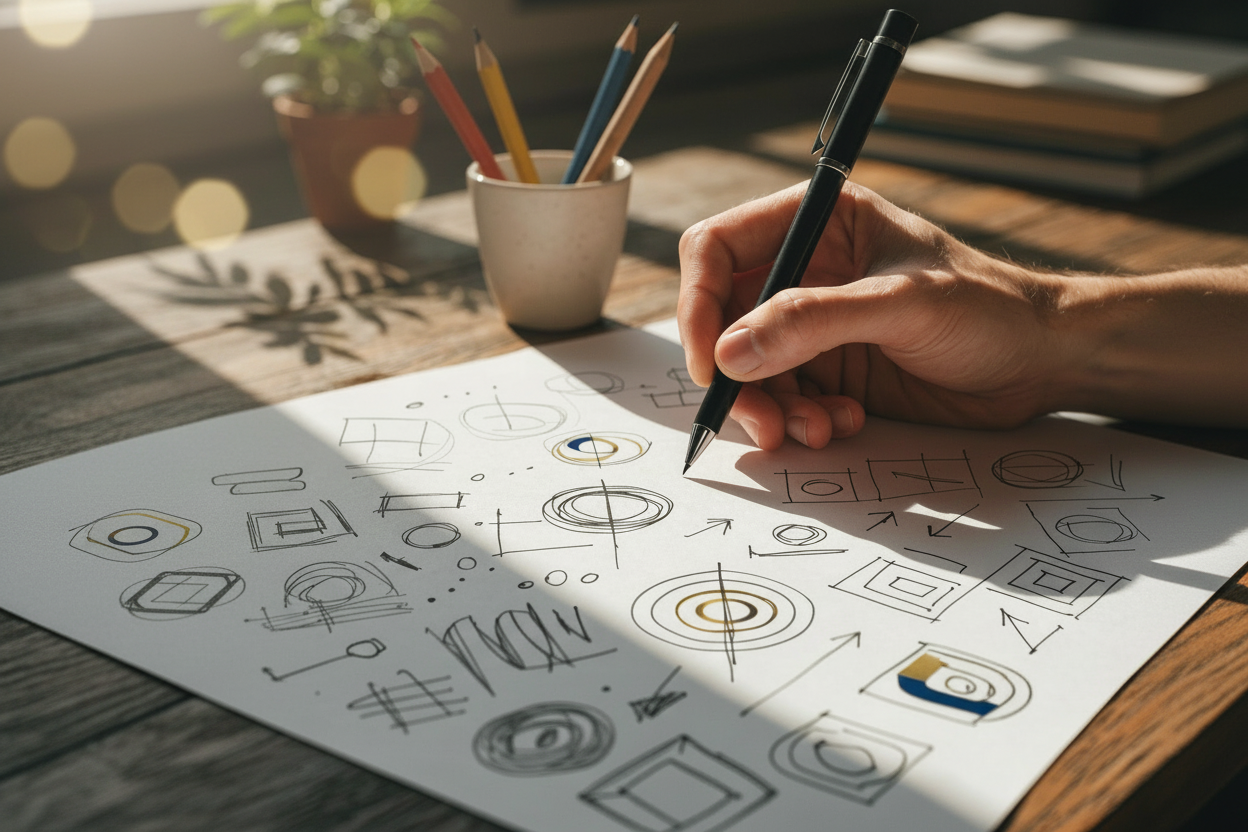
Stage 3: Sketching Studies. Moving directly to the computer and starting to click on the program is one of the biggest mistakes made by amateurs. Inspiration and creativity flow much more freely on paper. Make simple scribbles, draw dozens of different ideas and forms. They do not have to be perfect drawings; just pour the main idea, balance, and composition onto the paper. Select the three or four sketches with the most potential and prepare to transfer them to the digital environment.
Stage 4: Digitization and the Start of Vector Design. Transfer the sketches you have chosen to the digital environment using a professional logo design program. Create the flawless outlines of the logo by making vector drawings. Pay attention to the golden ratio or geometric perfection by using grid systems. At this stage, it is best to focus only on black and white forms without entering colors and detailed fonts yet. If the black and white form works, the colors will sit much better on it later.
Stage 5: Typography Selection and Color Palette Integration. After the emblem or form part of the logo is created, integrate the most suitable colors and fonts for the brand. Perform tests by putting different color combinations and font families side by side. Adjust the dimensional balance between the text of the logo and the emblem very well.
Stage 6: Presentation, Feedback, and Revisions. After completing your designs, step away for a while and evaluate them again with a fresh eye. Then, present it to your client or team by preparing mockups of the logo in different usage areas, such as how it looks on a t-shirt, on a sign, or on a business card. Objectively consider the criticisms received and make the necessary and logical revisions.
Stage 7: Final Delivery and Creation of the Corporate Identity Guide. Package and export the different versions of the final approved logo in industry-standard formats like AI, EPS, PDF, SVG, high-resolution PNG, and JPG. In addition, preparing a Brand Guidelines document explaining the rules such as how the logo should be used, what color codes it has, and how much space should be left around it is the pinnacle of professionalism.
4. COLOR PSYCHOLOGY AND TYPOGRAPHY SELECTION IN LOGO DESIGN
Colors and texts in logo design do not only provide a visually beautiful aesthetic; they also send very strong messages to the subconscious of the target audience. When we evaluate it in terms of SEO, these elements that directly affect the user experience build brand loyalty. Every color has a counterpart in human psychology, cultures, and market perception. You have to choose the strategic color suitable for your brand's message.
Red represents energy, passion, excitement, action, danger, and most importantly, appetizing qualities. It is a call-to-action color used by brands like Coca-Cola, Netflix, and YouTube. Blue represents trust, loyalty, professionalism, wisdom, technology, security, and peace. Banks, insurance companies, tech companies, and social media giants prefer blue for this reason. Yellow represents optimism, joy, attention, creativity, and youth. It represents the sun and is highly noticeable, but too much use alone can tire the eyes.
Green represents nature, organic life, growth, health, peace, and also finance and money. It is frequently used in eco-friendly products, vegan brands, and the healthcare sector. Black represents luxury, elegance, power, prestige, authority, and mystery. It is especially preferred in premium brands and fashion icons like Chanel, Nike, and Apple. Orange represents creativity, friendliness, adventure, enthusiasm, and fun. Brands appealing to young people use it a lot, such as Fanta and Amazon.
The font you choose determines the corporate tone of your logo. It doesn't just write text; it conveys emotion. Serif fonts have small projections at the ends of the letters. They give a traditional, respected, established, reliable, academic, and classic feel. They are ideal for law firms, newspapers, and established luxury brands. Sans-Serif fonts offer a modern, clean, minimalist, innovative, and much more suitable look for the digital world. Because their readability is high, technology companies, startups, and modern web brands frequently use them. Script fonts are elegant, personal, creative, nostalgic, and emotional. They are preferred in cosmetics, handmade products, boutique cafes, fashion, and artistic brands.
5. BEST PROGRAMS AND TOOLS FOR LOGO DESIGN
To create a successful logo design, it is not enough to just have a good idea; it is also essential to use the right tools that will turn the idea into reality. There are many software options available, from professional programs that have become industry standards to drag-and-drop tools ideal for beginners.
Adobe Illustrator is the first and arguably the best program that comes to mind worldwide when professional logo design is mentioned. It is completely vector-drawing based, meaning every line and every letter you draw is based on mathematical calculations and can be enlarged infinitely without loss of quality. CorelDRAW is Adobe Illustrator's biggest and most established alternative. It is very common, especially in the printing, signage, and CNC cutting sectors. Figma, which has become incredibly popular especially among web and UI/UX designers, is also a great alternative for logo design with its vector drawing capabilities, and its basic package is free.
Canva is your biggest savior if you are asking how to do free logo design, have no budget, and have zero professional design knowledge. It offers thousands of ready and categorized logo templates. It works with drag and drop logic. However, a major warning: a logo you make in Canva is never completely original because the wonderful template you chose may be used by tens of thousands of people in the world for their own small businesses. Finally, Affinity Designer is an extremely powerful, stable, and fast vector-based design program that you can own for a lifetime with a single reasonable license payment.
6. COMMON LOGO DESIGN MISTAKES AND WAYS TO AVOID THEM
While learning how to make a good logo, it is also very important to know what you should not do, which could ruin the process, damage your corporate identity, and make you look amateurish. The biggest mistake is working in non-vector pixel-based programs. Designing your logo in a pixel-based program like Adobe Photoshop is the biggest amateurish thing you can do. The logo will pixelate, become blurry, and turn into mud when enlarged or printed. Your logo must always be a vector under all circumstances.
Becoming a slave to trends and temporary fashions is another mistake. A font, a 3D effect, or a neon color that is very popular this year or this month may become completely outdated next year and make your brand look old. Focus on permanent, strong, and simple geometric forms rather than passing trends. Using too many fonts and typography is also dangerous. The ideal in a logo is to use one, or maximum two different fonts. Three or more fonts complicate the brand, tire the eyes, and disrupt the brand's identity integrity.
Drowning in complex, eye-tiring details is a common error. Think about how your logo will look in a tiny 2x2 centimeter area, like an Instagram profile picture on a phone screen. Complex illustrations containing very detailed, fine lines turn into mud when scaled down and are never read. Designing a color-addicted logo is also bad. If a logo loses its form, power, and intelligibility when printed in a single color just black and white, it is a failed logo. Always start the design in black and white; give the color after the main form is approved. Finally, stay absolutely away from cliches and ready-made stock vectors downloaded from the internet. Your brand is unique, and your logo must be a hundred percent original.
7. INSPIRING SUCCESSFUL LOGO DESIGN EXAMPLES AND ANALYSES
To reinforce the theoretical knowledge and rules, let us take a closer look at the world's most successful, million-dollar logo designs and the extraordinary hidden meanings behind them. These logos are proof of the intelligence behind simplicity. FedEx, the world's most famous logistics cargo company, has an arrow symbol perfectly hidden in the white space (negative space) between the letters E and x. This arrow represents the company's speed, precision, forward-looking vision, and direction.
Amazon's logo features a yellow curved arrow that at first glance reflects a warm smile representing customer satisfaction. But if you look closely, the arrow starts at the letter a and extends to the letter z. This visual message cleverly tells the consumer that you can find everything you are looking for from A to Z on Amazon. Apple's legendary bitten apple is another great example. Designer Rob Janoff says he added the bite to indicate scale so that a whole apple wouldn't be mistaken for a cherry when drawn from a distance. However, this word bite also creates a great pun with the computer term byte.
Toblerone's logo features the majestic Matterhorn mountain in the Swiss Alps. But if you focus carefully on the white snowy parts and shadows of the mountain, you will see a massive bear silhouette standing on its hind legs hidden there. This bear proudly represents the city of Bern, where the brand and chocolate were born, which is known as the City of Bears.
CONCLUSION: CREATE THAT LOGO THAT WILL SAFELY CARRY YOUR BRAND INTO THE FUTURE
Logo design is the most critical, most visible, and most important curve of your long and challenging branding journey. As we saw while answering the question of how to design a logo examined step by step in this giant guide, this process is not just about drawing an aesthetic and pleasing shape; it is a tremendous, balanced combination of serious strategy, consumer psychology, competitor research, and analytical creativity. To create a simple, memorable, timeless, and highly versatile logo, you must follow the steps carefully and never ignore your target audience and the core message your brand wants to convey.
FREQUENTLY ASKED QUESTIONS (FAQ)
Q: How long does a professional logo design process take on average? A: A logo design process carried out with agencies or professional designers generally takes between one to four weeks from preliminary research, brief reception, analysis, sketching, design, and delivery. Delivering a logo in one hour is usually an indication that a ready-made template is used or the process is not carried out professionally.
Q: What format or file type should I use when uploading my logo to my website and social media? A: The main design files of logos should always be kept in vector formats like AI, EPS, or PDF. However, if you are going to use your logo on a website or an infrastructure like WordPress, the SVG format, whose resolution never deteriorates, is the most ideal. For your social media profiles, the high-resolution PNG format supporting a transparent background is the most common and correct usage.
Q: Are the free logo making tools and programs on the internet really safe and sufficient? A: Free logo creator tools are software safe, but you may not be able to fully obtain the commercial copyrights of the logo you create. The graphic or template you choose may be used by thousands of other companies. If you aim to grow your brand and get a trademark registration, these ready-made templates will fall short and even be risky in creating a unique brand identity. A hundred percent original, vector designs drawn from scratch are a legal necessity for real trademark protection.
Q: Is it better if my logo consists only of its name, or should I use a symbol or emblem? A: This entirely depends on your sector and brand strategy. If the name is very strong, memorable, and short, a Logotype (just text) is an excellent choice. If you want to create a strong visual that will represent your company's service and values, the Logo and Emblem combination should be preferred. For entry-level brands, using both text and emblem together is more advantageous in terms of brand awareness.