
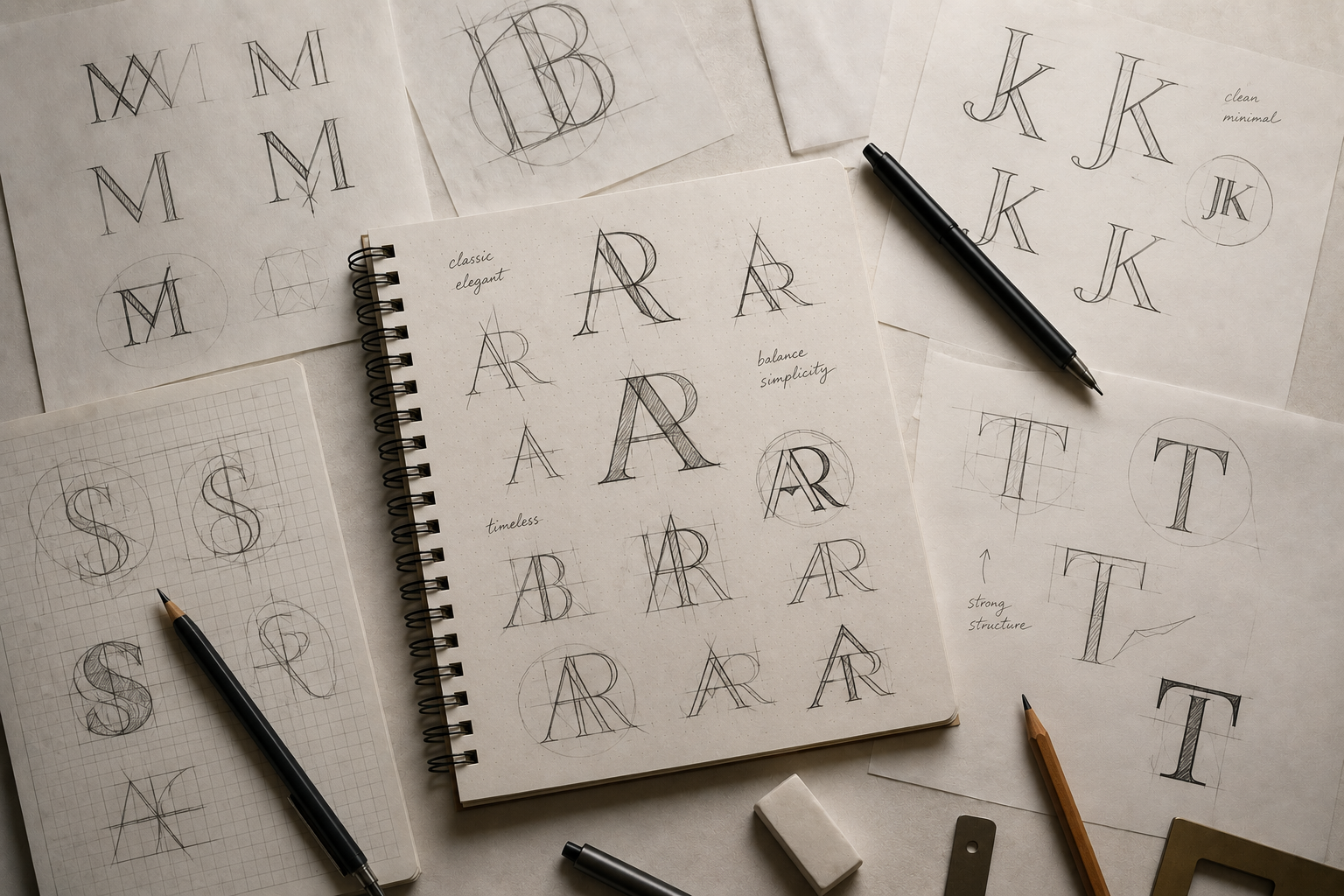
When exploring the highest echelons of corporate branding and luxury fashion, one specific architectural style dominates the visual landscape: the monogram logo. From the interlocking 'CC' of Chanel to the robust, unmistakable 'LV' of Louis Vuitton, monogram logos have been utilized for centuries to project absolute prestige, exclusivity, and supreme authority. But what exactly is a monogram logo, and why does this specific design format command such immense psychological weight in the modern digital economy? Understanding the mechanics of a monogram is essential for any business aiming to cultivate a highly refined, premium brand identity.
A monogram logo, frequently referred to in the graphic design industry as a 'lettermark', is a typography-based logo that consists exclusively of a few letters—usually a company's initials. Unlike complex pictorial marks or verbose logotypes, a monogram compresses a brand's entire corporate identity into a single, tightly interlocked typographic symbol. In this comprehensive, SEO-optimized guide, we will delve deep into the history of monograms, explore their profound psychological impact on consumers, and provide a masterclass on how to design the perfect monogram logo for your enterprise.
1. DEFINING THE MONOGRAM LOGO (LETTERMARK)
At its absolute core, a monogram logo is a distillation process. It takes a long, perhaps cumbersome corporate name and condenses it into a sleek, highly memorable visual acronym. For example, the broadcasting giant 'Home Box Office' is universally known by its powerful, geometric monogram: HBO. The 'National Aeronautics and Space Administration' is instantly recognized globally as NASA. The monogram logo serves an incredibly functional purpose: it solves the critical problem of having a business name that is simply too long or difficult to pronounce in a fast-paced global market.
By utilizing only the initials, a monogram logo relies heavily on the specific typographic treatment of those letters to convey the brand's personality. The letters are often interconnected, overlapping, or heavily stylized to create a unique, singular symbol rather than just a row of standard text. When executed correctly, a lettermark functions simultaneously as both typography and an abstract icon, offering the ultimate combination of legibility and visual flair.
2. THE HISTORY AND EVOLUTION OF MONOGRAMS
The monogram is one of the oldest forms of branding in human history. Its origins date back thousands of years to ancient Greece, where early monograms were stamped onto coins to identify the city-states that minted them. During the Middle Ages, master craftsmen and artisan guilds used monograms as highly coveted 'maker’s marks' to sign their sculptures, paintings, and architectural stonework, legally distinguishing authentic masterpieces from cheap forgeries.
In the modern era, the monogram evolved into the ultimate symbol of aristocratic luxury. In the late 19th and early 20th centuries, elite European fashion houses like Gucci, Fendi, and Yves Saint Laurent adopted the monogram as a status symbol, weaving their interlocking initials directly into the fabric of their premium luggage and couture garments. Today, the monogram has transcended its aristocratic roots, becoming a hyper-efficient, scalable digital asset favored by tech startups, global media conglomerates, and personal brands.
3. WHEN SHOULD YOU USE A MONOGRAM LOGO?
A monogram logo is not the perfect solution for every single business. However, it is absolutely mandatory under specific corporate circumstances. You should strongly consider utilizing an AI logo maker or a professional designer to create a monogram if your business name consists of three or more words. For instance, 'International Business Machines' is incredibly difficult to fit on a modern website header or a mobile app icon; thus, the legendary 'IBM' monogram was born, offering flawless digital scalability.
Furthermore, a monogram is the ideal choice if your brand aims to project an aura of high-end luxury, bespoke craftsmanship, or elite professional consulting. Personal brands (such as high-profile lawyers, independent architects, or fashion designers) frequently use their personal initials to create a monogram. However, if you are launching a completely unknown startup with a highly abstract or confusing acronym, a monogram might hinder your initial brand recognition unless the full company name is written directly underneath the symbol during the first few years of operation.
4. FAMOUS EXAMPLES OF MONOGRAM LOGOS
To truly understand the power of a lettermark, one must study the global titans that have mastered it. The 'CNN' (Cable News Network) logo is a brilliant example of a modern, continuous-line monogram. The red letters are seamlessly connected, resembling a massive electrical cable or digital data stream, perfectly symbolizing continuous, uninterrupted global news transmission. The 'VW' (Volkswagen) logo stacks the 'V' on top of the 'W' inside a perfect circle, creating a highly engineered, mathematically precise emblem that projects German automotive supremacy.
In the luxury sector, the interlocking 'GG' of Gucci or the overlapping 'YSL' of Yves Saint Laurent are not merely logos; they are highly coveted cultural status symbols. These monograms have been so perfectly engineered that they are used as repeating patterns on billion-dollar merchandise lines. Analyzing these famous examples reveals a common thread: absolute typographic mastery and a total lack of unnecessary visual clutter.
5. CHOOSING THE PERFECT TYPOGRAPHY FOR MONOGRAMS
Because a monogram logo strips away all pictorial symbols and relies solely on a few letters, the typography you choose is the only vehicle you have to convey your brand's psychological message. If your monogram uses a highly traditional Serif font with elegant, sharp feet, it will inherently project luxury, heritage, and establishment. This is why almost all high-end fashion and legal monograms utilize custom Serif typography.
Conversely, if you choose a bold, geometric Sans-Serif font, your monogram will project an image of modern, cutting-edge tech efficiency (similar to the 'HP' Hewlett-Packard logo). When designing a monogram, you must go beyond simply typing two letters on a keyboard. You must physically manipulate the vector anchors of the letters—perhaps removing a crossbar, joining two stems together, or altering the negative space—to transform standard typography into a unique, legally protectable, bespoke symbol.
6. INTEGRATING SYMBOLS AND HIDDEN MEANINGS
The most brilliant monogram logos often transcend simple lettering by hiding a secondary pictorial symbol within the negative space of the letters themselves. This technique requires elite design engineering but results in a massive boost to brand memorability. A famous example is the 'Baskin Robbins' monogram, where the pink segments of the 'B' and 'R' perfectly form the number '31', representing their famous 31 flavors of ice cream.
When conceptualizing your monogram, look for opportunities where the specific geometry of your initials might naturally form a shape relevant to your industry. Can the crossbar of an 'H' be turned into a building for a real estate firm? Can the curves of an 'S' and a 'C' interlock to form a camera lens? Integrating hidden meanings transforms your monogram from a static corporate abbreviation into a brilliant, engaging visual puzzle.
7. STEP-BY-STEP GUIDE TO CREATING A MONOGRAM
Designing a flawless monogram requires a strict, methodical approach. Step one: Write down your company's initials on a piece of paper and study their underlying geometry. Are they built with straight lines (like A, H, M, V) or curves (like O, C, S)? Step two: Experiment with interaction. Try overlapping the letters, interlocking them like rings, sharing a common stem, or mirroring them.
Step three: Move to a vector-based design software or a premium AI logo generator. Begin testing different font families (Serif vs. Sans-Serif) in stark black and white. Step four: Focus obsessively on legibility. If your interlocking letters become an unreadable knot of lines, you have failed. The initials must remain distinguishable. Step five: Apply your strategic brand color palette and finalize the vector scaling. By following this disciplined process, you will forge a monogram that acts as an indestructible visual anchor for your brand's future.